Are you tired of the rising cost of commercial chicken feed? It's frustrating to see your money disappear into bags filled with ingredients you can't even identify, worrying if it's truly healthy for your flock.
To make chicken feed at home, simply crush your grains, mix them with protein and supplements according to a balanced formula, and then run the mixture through a small flat die pellet machine. This process gives you total control over ingredients and can cut your feed costs by up to 30%.
- Don't let complex formulas intimidate you. The goal is to provide a balanced diet, and you can achieve that with a few basic, low-cost ingredients that are likely available locally. For small farms, consistency is more important than complexity. Starting with a proven base formula allows you to produce high-quality feed right away without needing to be a poultry nutritionist. As you get more comfortable, you can adjust the ratios to fit your flock's specific needs, whether for layers, broilers, or chicks.
A Starting Formula for Small Farms
This table breaks down a reliable, all-purpose formula you can use as your starting point.
| Ingredient Type | Example | Percentage in Mix | Purpose |
|---|---|---|---|
| Energy Feed | Corn, Sorghum, Barley | ~60% | Provides essential energy for daily activity |
| Protein Feed | Soybean Meal, Fish Meal | ~25% | Crucial for growth and egg production |
| Fiber/Filler | Wheat Bran, Rice Bran | ~10% | Aids in digestion and adds bulk |
| Additives | Vitamin/Mineral Premix | ~5% | Ensures complete nutrition and health |
What Are the 3 Simple Steps to Making Feed Pellets?
Knowing the ingredients is one thing, but turning them into actual pellets can seem like a daunting industrial process. Many farmers worry about needing multiple complex machines and a lot of space.
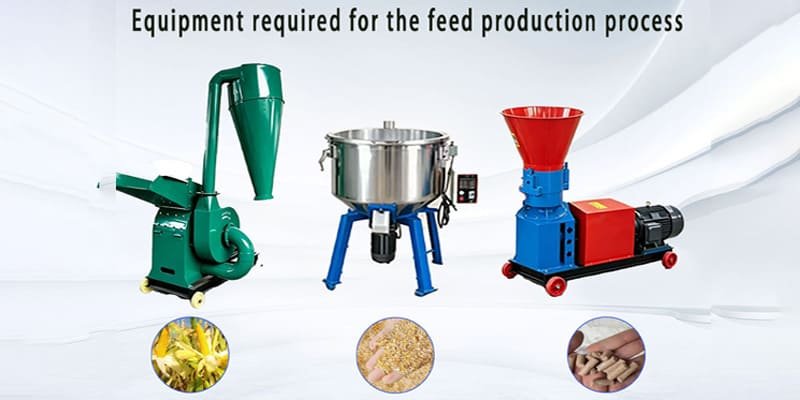
The process is just three simple steps: Crush your whole grains into a smaller size, Mix all your ingredients thoroughly to ensure a balanced feed in every bite, and Pellet the mixture using a compact flat die machine to create the final product.
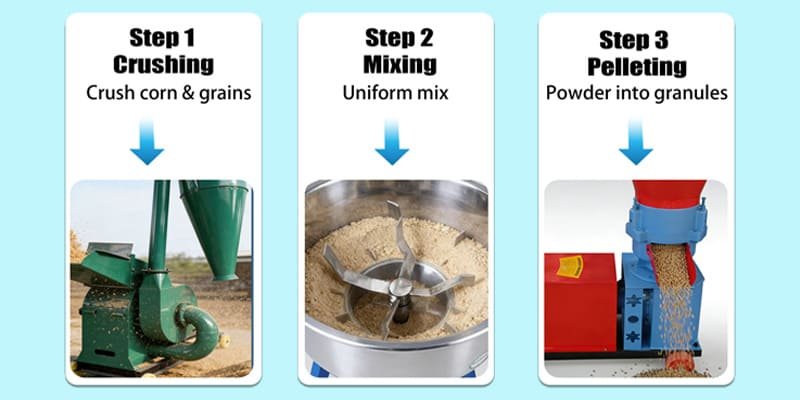
This isn't about building a massive production line. For a small farm, each step can be handled with simple, space-saving equipment. I've designed countless setups for smallholders that fit into the corner of a barn or a garage. The key is to keep it straightforward and focus on the quality of the final pellet. Let’s look at each step.
Step 1: Crushing
You need to break down large grains like corn so they can be mixed evenly and pass through the pellet machine. A small hammer mill is perfect for this. It's a simple machine that gets the job done quickly.
Step 2: Mixing
This step is crucial for nutrition. You need to ensure every pellet contains the right balance of corn, soy, and vitamins. You can do this by hand for very small batches or use a small feed mixer to guarantee a consistent blend.
Step 3: Pelleting
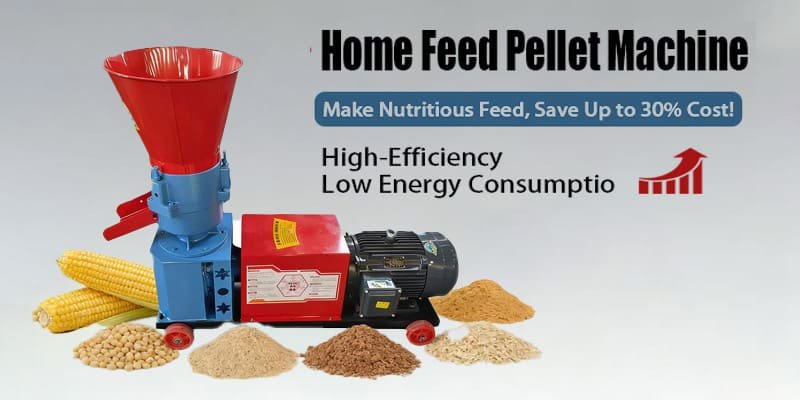
This is where the magic happens. The mixed powder is fed into a flat die pellet mill. For home or small farm use, this type of machine is ideal. It’s compact, easy for beginners to use, and often runs on the single-phase electricity you already have. It turns your loose mix into dense, easy-to-handle pellets.
Why Are Pellets Better Than Powder for Your Chickens?
You might wonder, "Why not just feed them the powder mix and save a step?" It’s a common question, but feeding powder often leads to significant waste and can even be less healthy for your flock.
Pellets prevent picky eating, ensuring each chicken gets a balanced diet instead of just picking out the tasty bits. Critically, the pelletizing process heats the feed to 70-85°C, killing harmful bacteria like Salmonella and making the nutrients easier to digest.
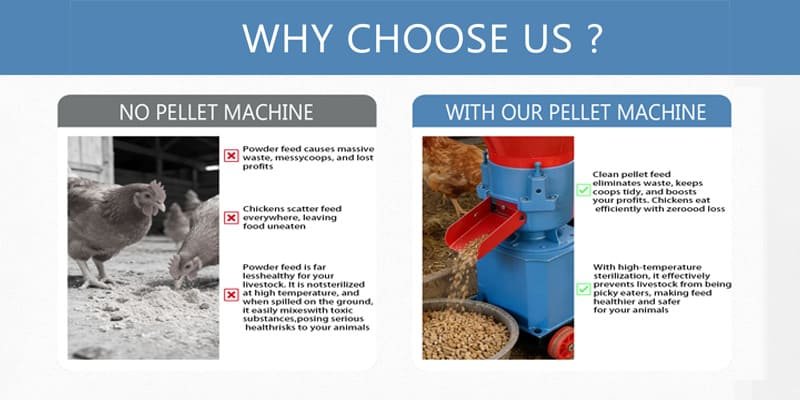
This last point is a huge benefit that many people overlook. I call it "high-temperature conditioning." When your feed mix passes through our STROSEN machine, the intense pressure and friction naturally heat it. This acts like a quick pasteurization, making the feed safer for your chickens. It also gelatinizes the starches in the grain, which increases the feed conversion rate. That means your chickens get more nutrition from the same amount of feed, which saves you even more money in the long run. Pellets aren't just about convenience; they are about less waste and better health.
Conclusion
Making your own chicken feed is not complicated. With the right formula and a reliable small machine, you can control ingredients, improve flock health, and significantly cut your costs.
FAQ Section
Question: How much does a small feed pellet machine for home use cost? Answer: A small flat die pellet machine is an affordable investment designed for small farms, offering a rapid return by saving you up to 30% on feed costs. The price is much lower than large-scale industrial equipment, making it highly accessible.
Question: How much space do I need to make my own feed at home? Answer: You don't need a lot of space at all. Our flat die machines are compact and space-saving, designed to fit easily into a garage, a small barn, or a workshop. The entire process—crushing, mixing, and pelleting—can be set up in a very small area.
Question: What kind of power supply does a small pellet machine require? Answer: Most of our machines designed for small farms and home use can run on single-phase electricity. This means you can plug it into the same type of electrical outlet you have in your home or workshop, without needing expensive three-phase power installation.
Inquiry Guidance
Ready to stop wasting money and start making fresh, healthy feed yourself? Let's find the perfect, easy-to-use setup for your farm.