
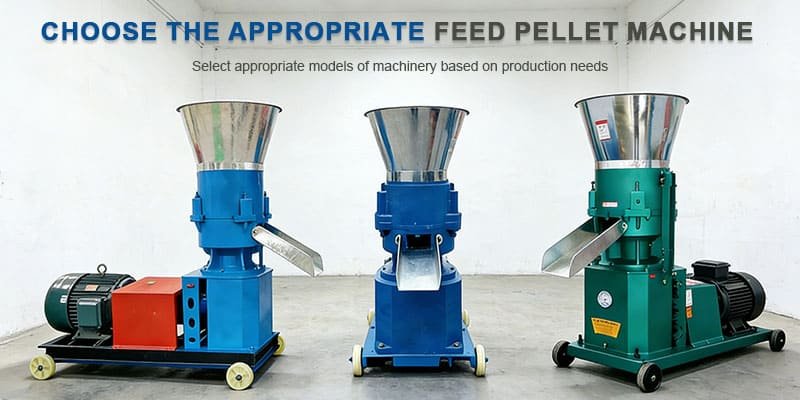
Buying the wrong size machine is a huge mistake. A small one bottlenecks your growth, while a large one wastes capital and energy, hurting your farm's profitability.
Calculate your total daily feed requirement1, then choose a machine that can produce this amount in 4-6 hours. This builds in room for future growth and avoids running your equipment at maximum stress, extending its operational life.
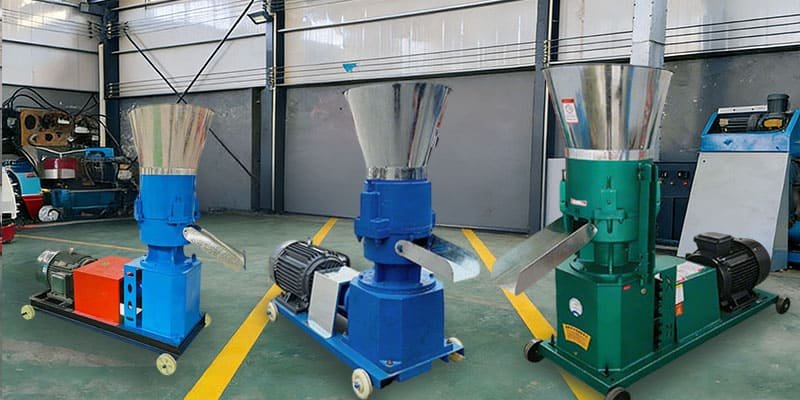
In my 16 years as a procurement advisor in agricultural machinery, I've seen it dozens of times. A farmer buys a machine based on today's herd size. A year later, their operation has doubled, but their machine hasn't. It is now the single biggest bottleneck preventing their success. Choosing the right production capacity2 isn't about guessing; it's about a simple calculation and a bit of forward-thinking. Get this right, and you have an asset that grows with you. Get it wrong, and you have an expensive problem. Let's break down how to do it right.
How do I calculate my total daily feed requirement1?
Guessing your feed needs leads to constant problems. You either produce too much, which wastes money and spoils, or too little, leaving your animals hungry and your operation inefficient.
Multiply the number of your animals by their average daily feed intake3 in kilograms. This gives you your total daily feed requirement1. Always use feeding guides4 for your specific animal type and age for the most accurate numbers.
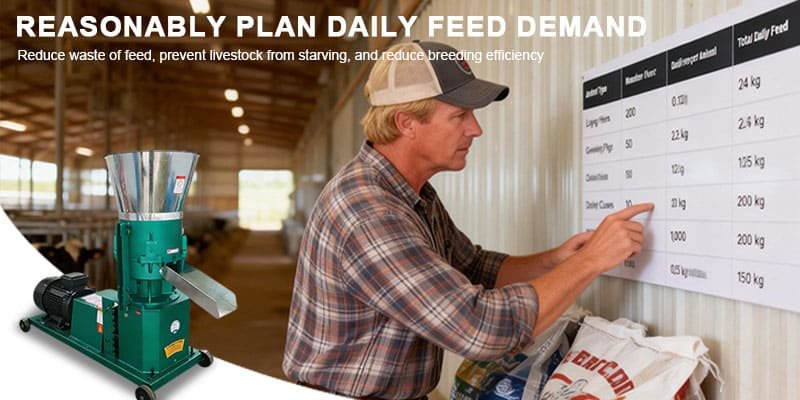
This simple calculation is the foundation of your entire decision. Before you even look at a single machine, you must know your demand. This number varies greatly by animal type, age, and production stage5 (e.g., growing vs. lactating). For example, a flock of 200 laying hens might eat about 24 kg of feed per day, while 10 dairy cows could consume over 200 kg daily. Don't rely on generic estimates. Find a reliable feeding chart from an agricultural extension service or veterinarian for your specific livestock. Once you have that total daily number, you have your absolute minimum production target. This grounds the entire conversation in facts and prevents a costly misjudgment.
Example Daily Feed Calculations
| Animal Type | Number of Animals | Daily Feed per Animal | Total Daily Feed |
|---|---|---|---|
| Laying Hens | 200 | 0.12 kg | 24 kg |
| Growing Pigs | 50 | 2.5 kg | 125 kg |
| Dairy Cows | 10 | 20 kg | 200 kg |
| Broiler Chickens | 1,000 | 0.15 kg | 150 kg |
Should I buy a machine with more capacity than I need6 right now?
Your farm is growing, but your small machine is running nonstop just to keep up. This constant stress leads to breakdowns, costly repairs, and frustrating production halts.
Yes, you should always choose a machine with more capacity than your immediate daily needs. A good rule is to select a model that can produce your daily feed in 4-6 hours. This strategy builds in room for growth and extends machine lifespan7.
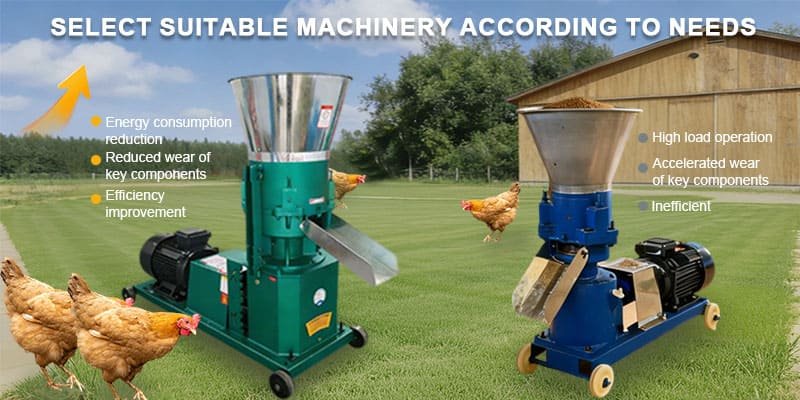
This is where strategic thinking saves you a lot of money in the long run. A machine rated for 100 kg/h that is forced to run for 8 hours straight to produce 800 kg of feed is under constant, maximum stress. Its motor runs hot, and key components like the rollers and die wear out much faster. Now, consider a machine rated for 200 kg/h. It can produce the same 800 kg of feed in just 4 hours, running at a comfortable, efficient load. This is the sweet spot for operational health. It reduces energy consumption8 per pellet and dramatically lowers wear and tear. At STROSEN, our critical components are designed for over 8,000 hours of use, but you only achieve that remarkable lifespan by operating the machine smartly, not by pushing it to its absolute limit every single day. The small extra investment upfront pays for itself in reduced maintenance and future-proofing your operation.
How do I match my production needs to a STROSEN model9?
Looking at all the different model numbers and technical specs is confusing. You're worried you'll pick a machine that's too big or too small, wasting your money either way.
We simplify this for our clients. Match your calculated daily need to a machine that produces that amount in 4-6 hours. For example, if you need 1,000 kg per day, look for a machine with a capacity around 200-250 kg/h.
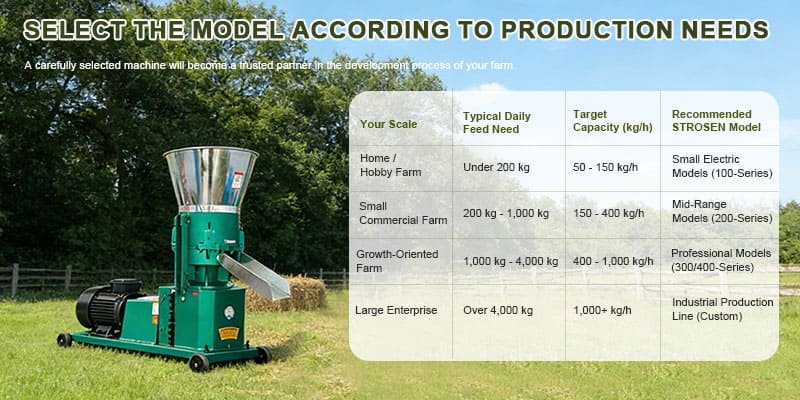
We've designed our product lines to make this choice straightforward. You don't need to be an engineer; you just need to know your production goals from the first step. After you calculate your daily feed requirement, you can easily find your fit. This approach ensures you buy a machine that serves you, not a machine that you have to serve. Many of our clients are small but growing commercial farms10, and we've helped them scale successfully by applying this simple logic. A well-chosen machine becomes a reliable partner in your farm's growth.
Recommended Capacity by Farm Scale
| Your Scale | Typical Daily Feed Need | Target Capacity (kg/h) | Recommended STROSEN Model |
|---|---|---|---|
| Home / Hobby Farm | Under 200 kg | 50 - 150 kg/h | Small Electric Models (100-Series) |
| Small Commercial Farm | 200 kg - 1,000 kg | 150 - 400 kg/h | Mid-Range Models (200-Series) |
| Growth-Oriented Farm | 1,000 kg - 4,000 kg | 400 - 1,000 kg/h | Professional Models (300/400-Series) |
| Large Enterprise | Over 4,000 kg | 1,000+ kg/h | Industrial Production Line (Custom) |
This table provides a clear path from your needs to a solution. As your partners, we can provide customized solutions to perfectly match the unique demands of your agricultural operation.
Conclusion
Calculate your daily feed need11s, select a machine that can produce it in 4-6 hours, and you will have made a smart, profitable investment for your farm's future.
Calculating your total daily feed requirement is crucial for efficient farm management. ↩
Understanding production capacity helps you choose the right machine for your farm's growth. ↩
Knowing average feed intake ensures you meet your animals' nutritional needs effectively. ↩
Feeding guides provide accurate data tailored to your specific animals, enhancing their health. ↩
Understanding production stages helps optimize feeding strategies for better livestock performance. ↩
Investing in a machine with extra capacity can save costs and improve efficiency in the long run. ↩
Knowing how to extend machine lifespan can lead to significant savings and better performance. ↩
Reducing energy consumption not only saves money but also promotes sustainable farming practices. ↩
Exploring STROSEN models helps you find the right fit for your specific production needs. ↩
Learning best practices can enhance productivity and profitability for small commercial farms. ↩
Determining daily feed needs is essential for maintaining animal health and farm efficiency. ↩

-300x150.jpg)