You want to produce your own animal feed, but traditional production lines are expensive and require a huge amount of space. This can make starting your own feed production seem impossible.
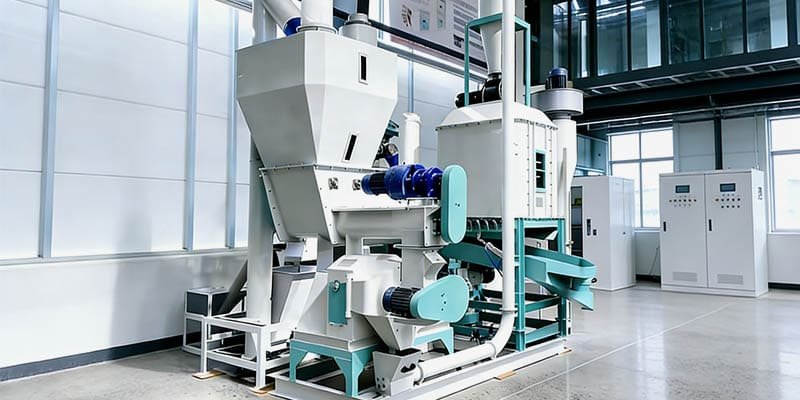
Our Modular 250 Pellet Plant integrates a grinder, mixer, pellet mill, and cooler into a single unit that fits in just 16 square meters. It gives you a complete, low-cost production line from a single factory source.
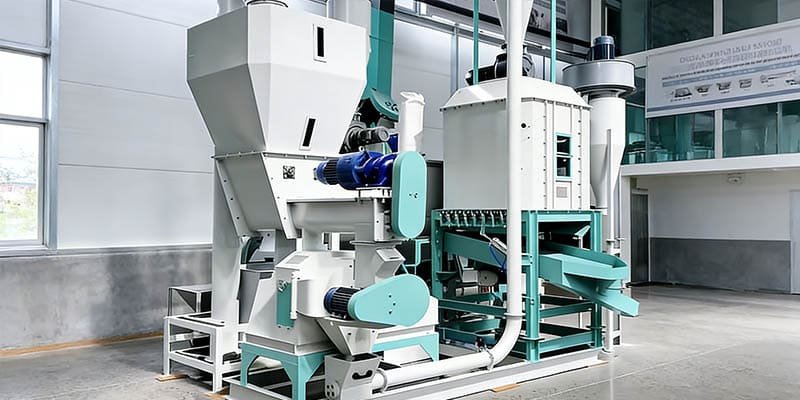
Controlling your own feed production gives you power over quality and cost. But the high investment and large factory footprint of traditional setups are major barriers. As a manufacturer with 16 years of experience, we designed the Modular 250 Pellet Plant specifically to solve this problem. It's a complete, "plug-and-play" solution that makes professional feed production accessible for farms and smaller feed mills. Let's break down how each module works together to turn raw materials into high-quality feed.
How Are Raw Materials Prepared for Pelletizing?
If your raw ingredients are not ground and mixed properly, your final feed pellets will be inconsistent. This leads to poor animal nutrition, wasted material, and a low-quality product.
Our system uses a 15 kW multi-function grinder to process diverse materials, followed by a high-efficiency mixer that achieves a mix uniformity of CV≤7% in just 3-6 minutes.
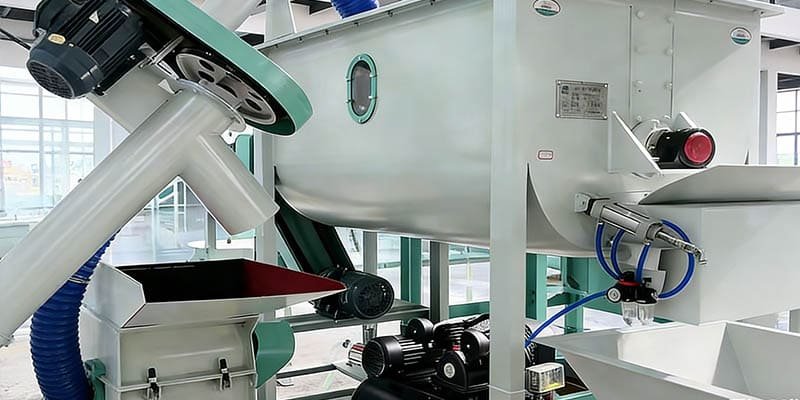
The first stage of production is critical for quality. Our modular plant starts with two robust components designed to work together perfectly.
Step 1: The Multi-Function Grinder
This is the workhorse that prepares your raw materials. It is powered by a strong 15 kW motor, giving it enough force to handle a wide variety of ingredients. You can feed it dry materials like straw, grass, and all types of grains. This versatility means you can create different feed formulas with a single machine, saving you the cost of buying separate equipment. It grinds everything down to a consistent particle size, which is essential for the next step.
Step 2: The Horizontal Ribbon Mixer
Once ground, the materials move into the mixer. We use a horizontal single-shaft, double-ribbon mixer with a capacity of 0.6 cubic meters per batch. Its design ensures a fast and incredibly thorough mix. In just 3 to 6 minutes, it blends all ingredients, including vitamins and minerals, to a uniformity level measured as a Coefficient of Variation (CV) of 7% or less. This high level of precision guarantees that every single pellet contains the same balanced nutrition.
How Does the Plant Turn Mash into Pellets?
You need to turn your mixed mash into durable, easy-to-handle pellets. An underpowered or inefficient pellet mill will produce soft, dusty pellets and have a very low output.
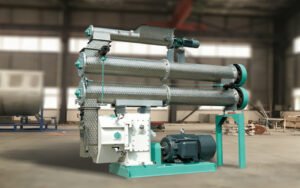
The heart of the plant is our 250 Ring Die Pellet Mill. Driven by a 22 kW main motor, it can produce up to 1 ton of grain-based pellets per hour.
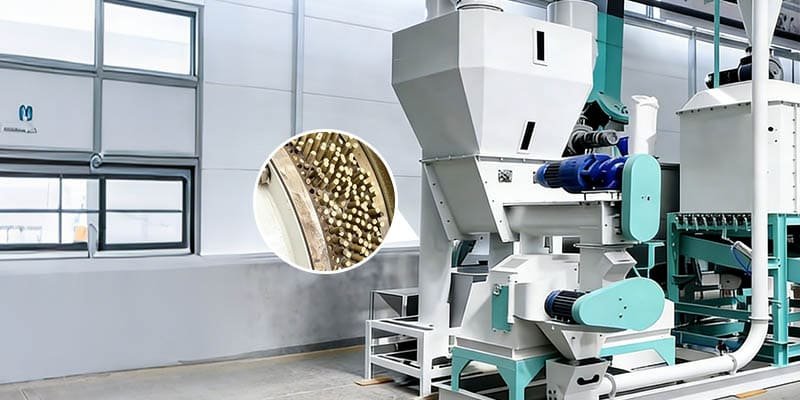
After the mash is perfectly mixed, it is fed into the pelletizing module. This is where the magic happens. We chose our Model 250 Ring Die Pellet Mill for this plant because it is reliable, efficient, and powerful. The 22 kW motor provides consistent torque to force the mash through the die, creating dense and uniform pellets. The machine's output capacity depends on the raw materials you use, as fibrous materials require more energy to compress.
Here is a clear breakdown of its performance:
| Raw Material Type | Max Production Capacity | Ideal For |
|---|---|---|
| Grain-Based Feed | 1,000 kg (1 ton) per hour | Pig, chicken, cattle feed |
| Grass Meal / Forage | 400 kg per hour | Sheep, cattle, rabbit feed |
This level of production makes the plant suitable for both large-scale animal farms and small commercial feed mills. It’s also versatile enough to produce feed for pigs, chickens, cattle, sheep, and even aquatic animals, depending on the die configuration you choose.
How Are the Pellets Finished for Storage and Use?
Hot pellets coming directly from the mill are soft, moist, and will crumble easily. If you bag them immediately, they will grow mold, spoiling the entire batch and wasting your investment.
The final module is a post-processing system with a 1 cubic meter counterflow cooler and a vibrating sieve. It ensures finished pellets have ≤14% moisture and are ready for bagging.
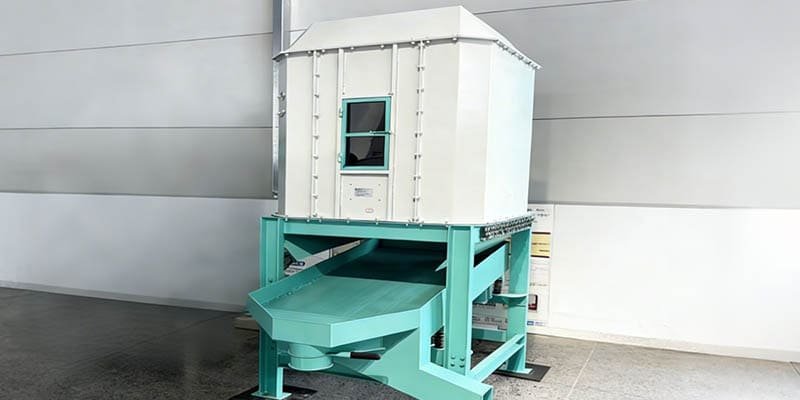
Finishing is just as important as pelletizing. To create a stable, high-quality final product, the pellets must be cooled and cleaned. Our integrated system handles this automatically.
The Counterflow Cooler
The pellets enter the 1 cubic meter cooler, where streams of air are pulled through them. This process is called counterflow cooling and it is very efficient. It quickly brings the pellet temperature down to just 3-5°C above the room temperature. More importantly, it reduces the moisture content to a safe level of 14% or less. This hardens the pellets, makes them durable for handling, and prevents mold growth, extending their shelf life significantly.
The Vibrating Sieve
After cooling, the pellets pass over a vibrating sieve. This final quality control step separates any fine powder or broken pieces from the perfect pellets. The finshed, uniform pellets proceed to the outlet for bagging, while the fines can be collected and re-introduced into the mixer, meaning there is almost zero waste in your production process.
Conclusion
This modular 250 plant offers a complete, efficient, and space-saving solution, making professional feed production an affordable reality for your farm or business from a factory-direct source.